

Pages (2)
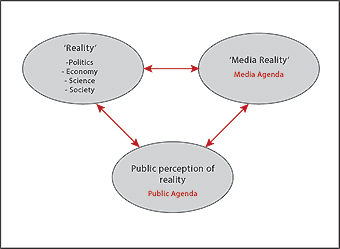
Media Tenor compares the relationship between reality and the media's description of reality or public perception of this reality as described by these media. Its applied Agenda Setting research has proved that media shapes peoples' minds. Consequently, topics not discussed in the media have proven to be irrelevant or less relevant by public.
Public opinion and even more importantly, human behaviour tends to follow media reporting. Ongoing up-to-date media content analysis represents the first step of Agenda Setting research. Media Tenor's approach of analysing all texts published in opinion leading media allows it to define 100% of all news reaching the people. Connecting this with public opinion polls or behaviour, Media Tenor can define how many reports are needed to make people change their opinion or behaviour.
The Media Tenor research is conducted in two steps:
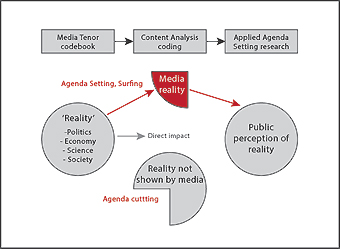
- Every day, media analysts encode every single information unit from all articles or new stories of more than 5 lines/seconds in print or broadcast texts from the opinion leading media of the selected country under analysis. The Media Tenor codebook is not based on topics, protagonists, or sources appearing in the media but rather reflects reality. The Media Tenor Codebook has developed over the last 13 years and has, due to daily updates, now reached the stage where it contains more than 100 000 codes each organised in logical categories reflecting the reality and the media content.
- Researchers then take this data and describe what was written in the opinion leading print media or broadcast on screen in TV News. This data, which is unique to Media Tenor, is then correlated with public opinion polls, and voting results to determine what reality is shown (Agenda Setting) in the media and what reality is not shown (Agenda Cutting). Further, these results are compared to external statistics (poll results, consumer behaviour reports, various indexes like business consumer index, consumer confidence index, share price, tourist statistics, etc) and further research to gauge the media effects on public perception and behaviour.
Since ancient Greece, public interest has not only become ever more diverse, but also ever more important due to the advent of modern democracy. Now, those in office need to know about and take into consideration these diverse needs across all segments of society. It is also indispensable for a democracy that its citizens are adequately informed about the decisions taken by its parliament.
The media provide exactly this bridge: On the one hand, they are a source for those in power to tap into the interest of the public. On the other hand, they provide citizens with information. This increasing diversity and importance of public interest coupled with the pivotal function of the media renders the way the media report crucial. Therefore, Media Tenor honors those media which excel at showcasing both how diverse the public interest is and how multifaceted the decisions taken by parliaments are with special awards.
Furthermore, institutions (e.g. universities and NGOs) strive to get their viewpoint across to the media. Even entire countries aim to be recognized by the international media. Media Tenor gives awards to those institutions and countries which are most successful in their communication efforts while also adhering to certain core virtues when communicating their message, such as diversity and transparency.
Importantly, Media Tenor does not rely on a jury to determine the winners of the awards. Rather, this decision is based on the careful in-depth analysis of an entire year’s worth of newspaper articles and television news broadcasts. This means that winners of the awards are identified through objective empirical numbers rather than subjective evaluations.
15th Agenda Setting Conference